Spelling Bee













Spelling Bee Game Introduction
If you've ever flipped through the puzzle section of The New York Times, you've probably stumbled across a vibrant little hive of letters teeming with activity. That's Spelling Bee — a daily word puzzle treasure to readers, lovers of words, and puzzle enthusiasts all over the globe.
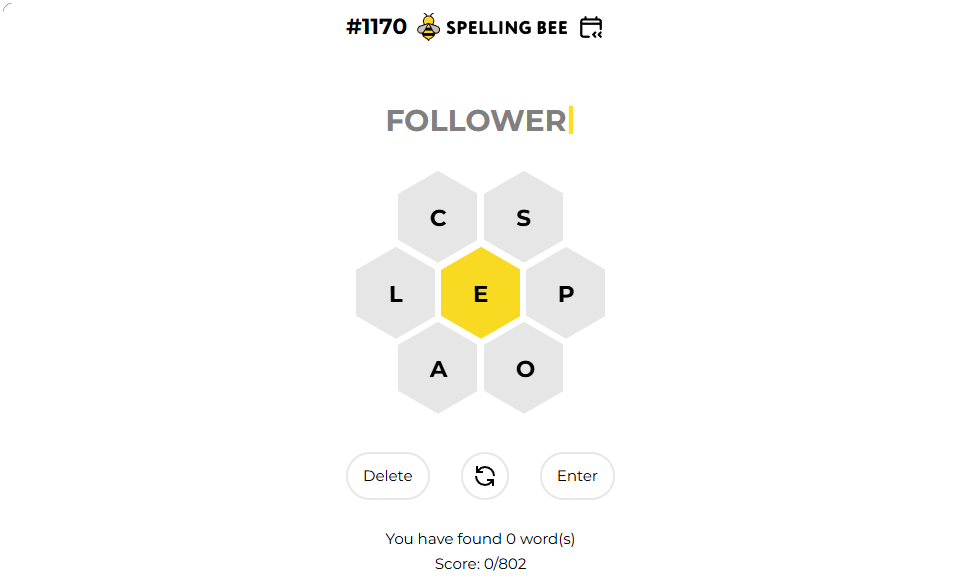
The premise is simple, at first: a honeycomb of seven letters blossoming like a flower — six on the outer petals, and one in the middle. Don't let that minimalist design fool you. What appears to be a simple game hides one of the most addictive, brain-tickling games hidden on the interweb.
Every day, you'll be presented with a new puzzle of letters in which you will be challenged to make as many words as you can with seven letters. The center letter is always used, and each word must be a minimum of four letters long. It's worth mentioning that letters can be used more than once, opening you up to fun combinations and moments of inspiration.
How to Play Spelling Bee
Spelling Bee is a simple game that is easy to learn but is surprisingly hard to master. Each round is a fun mix of creativity, spelling, and pattern recognition challenge all at once.
Basic Rules
- You will find seven letters arranged into a honeycomb shape.
- The center letter must occur in all words you create.
- All words must be at least four letters long.
- You can use letters, even the center letter, in as many words as you want.
- You can only use real words from the dictionary- no proper nouns and no slang.
Example: If one of the letters from the seven is “P” and the center letter is “A”, the combinations of possible words could be papa, apart, and apparatus, which does require some thought to think of potential combinations.
Scoring and Progression
You get points for each word based on the number of letters in the word. The more letters, the more points. Further, if you find every possible word, or if you find the word that uses all 7 letters, you will receive special titles, such as:
- Nice – you’re off to a good start.
- Amazing – your vocabulary is shining bright.
- Genius – you’ve conquered today’s hive!
- Queen Bee – you found every possible word!
Keep in mind, the bees do produce a new hive each day, so your challenge—and bragging rights—begin from scratch... again. Many fans make the Spelling Bee puzzles’ regular part of their daily routine, as little moments of focus and fun, similar to contemplating finishing a crossword.
How to Become a Hive Master
Looking to get into the Genius rank faster? Here are some quick recommendations:
- Begin with the letter basics - figuring out good four-letter words can set the tone.
- Look for prefixes/suffixes – words such as “re-”, “ing”, “ed,” or “tion” can provide you with some phrases.
- Try different letter patterns – flipping the letters or duplicating letters sometimes can provide better phrases.
- Take a break – walking away from the puzzle often helps your brain to see the hidden words once you return.
- Remember: the middle letter is your pivot letter. Every word needs to have the center letter – just like the bees will always return to the queen.
So, are you ready to buzz?
Spelling Bee is not a word puzzle; it’s a daily habit for those who love language. It is a test of wit and patience, even repurposing letters for logic, then turning logic into pleasure. You may only play it for a few minutes before and after meals, or become lost trying the impossible goal of Queen Bee rank. It is easy to see why the Spelling Bee has become a classic in the New York Times without Googling today.
Get your dictionary (mind) open and see if you’re up for the challenge to see if you can become the next Spelling Bee Genius.
Discuss: Spelling Bee